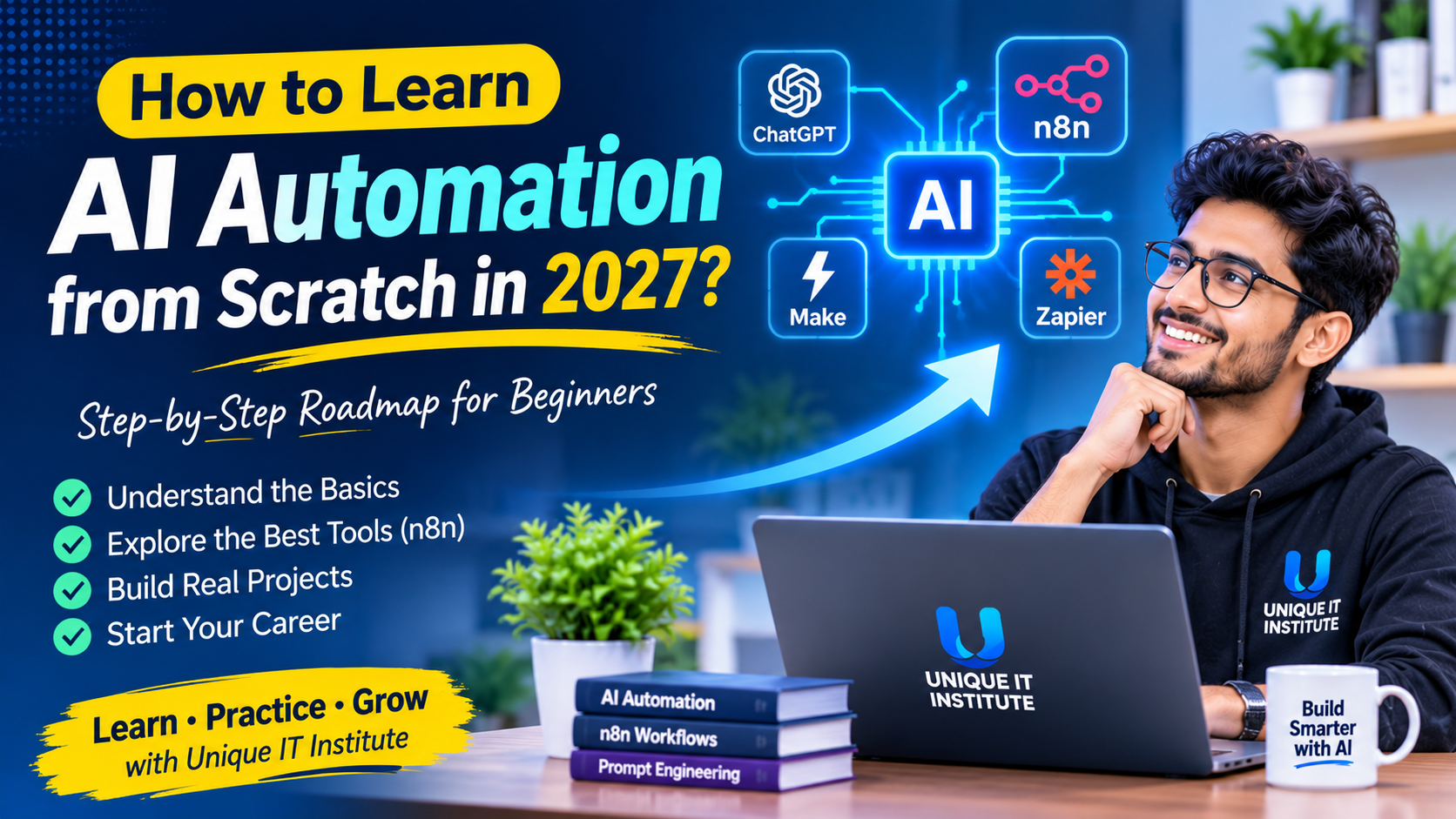
How to Learn AI Automation from Scratch in 2027: A Complete Beginner's Roadmap
Artificial Intelligence is transforming the way people work, communicate, and run businesses. From automated customer support to intelligent business workflows, AI-powered technologies are creating new opportunities for students, freelancers, entrepreneurs, and professionals.
One of the most exciting areas of this transformation is AI Automation.
Businesses are no longer interested in using AI only to generate text or images. They want intelligent systems that can manage customer inquiries, collect leads, process information, automate emails, update databases, and perform repetitive tasks with minimal human intervention.
This growing demand makes AI automation an interesting skill to learn in 2027.
But how can you learn AI automation if you have no technical background? Which tools should you learn first? Do you need programming skills? And how can you turn your knowledge into a career or freelancing opportunity?
In this complete beginner's guide, we will explain how to learn AI automation from scratch, which tools to explore, and how to build practical projects step by step.
What Is AI Automation?
AI automation is the combination of artificial intelligence and workflow automation to perform tasks, process information, and improve business operations.
Traditional automation follows predefined rules. For example, when someone submits a website contact form, an automated system sends an email notification.
AI automation adds intelligence to this process. It can understand customer messages, classify inquiries, generate personalized responses, extract important information, and decide which workflow should handle a request.
For example, an AI-powered customer support system can:
Understand customer questions.
Generate relevant answers.
Retrieve information from a knowledge base.
Collect customer details.
Update a CRM or Google Sheet.
Send notifications to support employees.
Escalate complicated issues to a human agent.
The goal is to combine automation with AI capabilities to create more intelligent and efficient business processes.
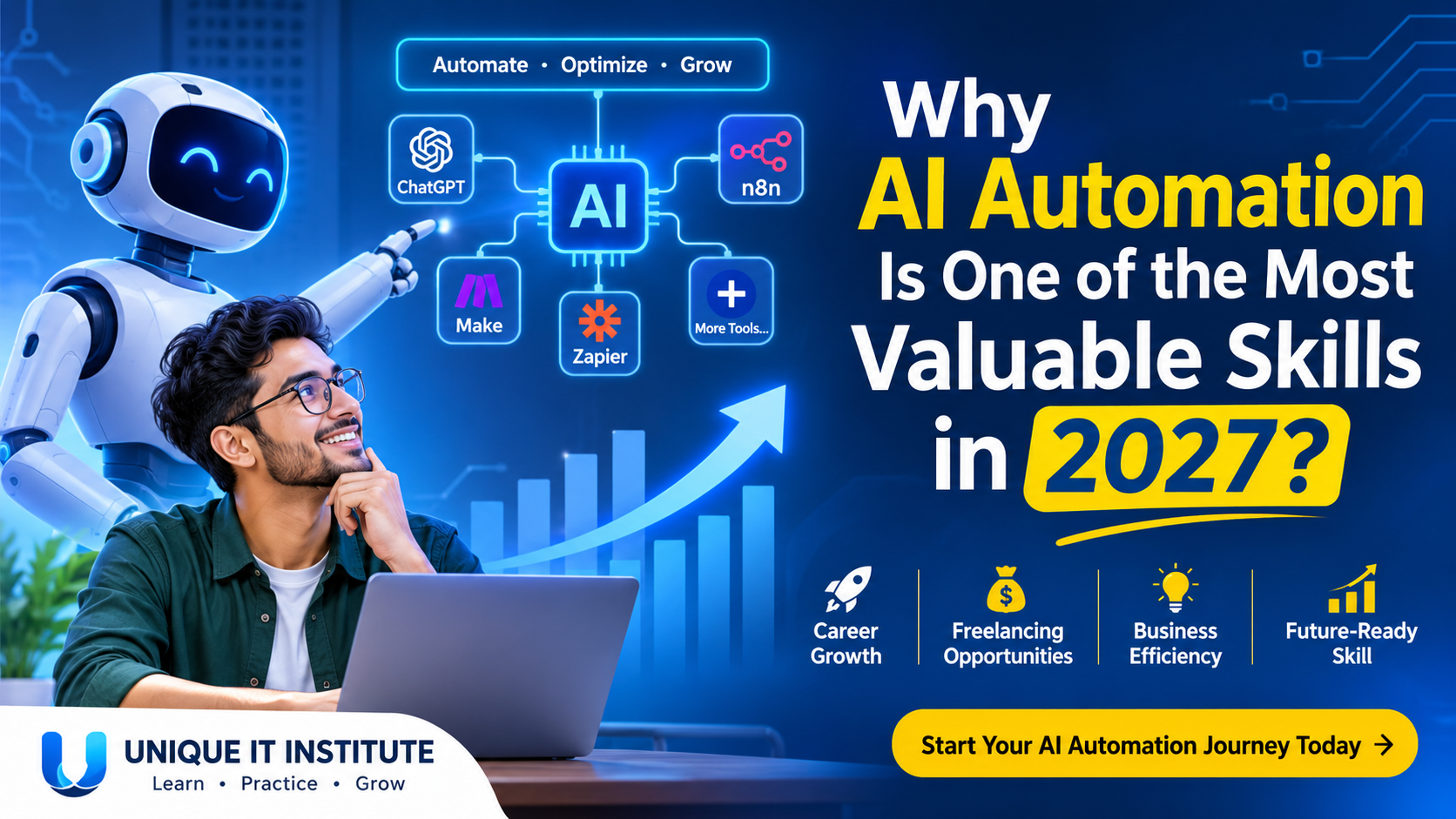
Why Should You Learn AI Automation in 2027?
AI automation is becoming relevant across industries because organizations want to improve productivity and reduce repetitive work.
Here are some reasons why learning this skill can be valuable:
1. Growing Business Adoption: Businesses are exploring AI-powered systems to improve customer service, marketing, sales, and internal operations.
2. Freelancing Opportunities: Companies need professionals who can connect applications, build automated workflows, and develop AI-powered solutions.
3. Business Efficiency: Automation can help reduce manual work, improve response times, and organize business processes.
4. Career Development: AI automation combines technology, problem-solving, and business knowledge, creating opportunities across different professional fields.
5. Entrepreneurial Opportunities: You can use your knowledge to develop automation services or establish an AI automation agency.
Learning AI automation does not guarantee a job or income, but practical skills and a strong project portfolio can help you compete for emerging opportunities.
Step-by-Step Roadmap to Learn AI Automation from Scratch
If you are completely new to AI automation, follow this structured learning roadmap. You do not need to master every tool at once. Focus on understanding the fundamentals and building practical projects.
Step 1: Understand the Fundamentals of Artificial Intelligence
Before building automated workflows, you should understand the basic concepts of artificial intelligence.
Start by learning:
What is Artificial Intelligence (AI)?
What is Machine Learning?
What is Generative AI?
What are Large Language Models (LLMs)?
How does ChatGPT work?
What is Prompt Engineering?
What are AI Agents?
You do not need advanced mathematics or machine learning knowledge to start building no-code AI automation workflows.
Begin by experimenting with AI tools such as ChatGPT, Claude, and Google Gemini.
Practice writing prompts, summarizing information, extracting data, generating responses, and classifying customer messages.
The objective is to understand what AI models can do and where their limitations are.
Step 2: Learn Workflow Automation
Workflow automation is the foundation of AI automation.
Before building advanced AI agents, learn how applications communicate and how automated processes work.
A typical automation workflow contains:
Trigger: Starts the workflow when an event happens.
Action: Performs a specific task.
Condition: Determines which path the workflow should follow.
Data: Transfers information between applications.
Output: Produces the final result.
For example, imagine someone submits a contact form on your website.
An automated workflow could:
Receive the form submission.
Collect the customer's name and email.
Save the information in Google Sheets.
Send a confirmation email.
Notify the sales team through Telegram.
This is a basic workflow automation system.
Start with simple workflows before introducing AI into more complicated processes.
Step 3: Choose an AI Automation Platform
Choosing the right automation platform is an important step in your learning journey.
There are several platforms available, but beginners should focus on learning one platform properly.
Here are four popular options:
1. n8n
n8n is a powerful workflow automation platform that allows users to connect applications, APIs, databases, and AI services.
It is particularly useful for building customizable workflows, AI agents, and business automation systems.
Official Website: https://n8n.io/
2. Make
Make is a visual automation platform that helps users connect applications and create automated workflows.
It is useful for beginners who want to understand automation through a visual interface.
Official Website: https://www.make.com/
3. Zapier
Zapier allows users to automate tasks between thousands of supported applications.
It is suitable for connecting business applications and automating repetitive activities.
Official Website: https://zapier.com/
4. Pabbly Connect
Pabbly Connect is another workflow automation platform that helps businesses connect different applications and automate processes.
Official Website: https://www.pabbly.com/connect/
Which platform should you learn first?
If your goal is to develop advanced AI workflows, connect APIs, and build intelligent automation systems, n8n is an excellent platform to explore.
You can start with the basics and gradually move toward AI agents and advanced integrations.
Step 4: Learn n8n from Beginner to Advanced
If you want to become an AI automation professional, learning n8n can be a practical starting point.
n8n uses a visual workflow editor where you connect different nodes to perform automated tasks.
Important concepts to understand include:
Nodes and connections.
Triggers and actions.
Workflow executions.
Scheduling.
Conditional logic.
Data transformation.
HTTP Request.
API integration.
Webhooks.
Error handling.
Credentials and authentication.
Start by creating simple workflows and gradually increase their complexity.
For example, build a workflow that collects website form submissions and automatically saves them to Google Sheets.
Then add email notifications and AI-powered message classification.
The official n8n Academy provides free structured learning courses, practical exercises, and completion certificates or badges. Its learning path covers workflow fundamentals, integrations, APIs, and AI agents.
You can also explore the official n8n documentation to understand individual nodes and workflow features.
Step 5: Understand APIs, Webhooks, and JSON
Once you understand basic workflow automation, it is time to learn how applications communicate with each other.
Three important concepts are APIs, webhooks, and JSON.
What Is an API?
An Application Programming Interface (API) allows different software applications to communicate and exchange information.
For example, an automation workflow can use an API to send information to an AI model and receive a generated response.
What Is a Webhook?
A webhook allows an application to send information automatically when a particular event occurs.
For example, when a customer submits an online form, a webhook can immediately send the submitted information to an n8n workflow.
What Is JSON?
JSON is a common data format used to exchange structured information between applications.
Learning these concepts will make it easier to connect different services and troubleshoot automation workflows.
You should also become familiar with API keys, authentication, HTTP methods, and basic JavaScript.
These skills are especially useful when building advanced automation systems.
Step 6: Learn How to Integrate AI into Workflows
After understanding workflow automation and API integration, start connecting AI models to your workflows.
AI integration allows automated systems to understand information, generate responses, classify data, and perform intelligent tasks.
For example, you can connect an AI model to n8n to create:
AI-powered email assistants.
Customer message classification systems.
Automated content generation workflows.
AI-powered lead qualification systems.
Document summarization tools.
Customer support chatbots.
Start with simple AI tasks.
For example, create a workflow that receives a customer message, sends it to an AI model, identifies the customer's intent, and saves the result in Google Sheets.
Explore the OpenAI developer documentation to learn about AI model integration and available tools.
Step 7: Learn to Build AI Agents
AI agents are an important part of modern AI automation.
An AI agent is a system that uses an AI model, instructions, and connected tools to perform tasks based on user requests.
Unlike a basic chatbot that mainly generates answers, an AI agent can interact with external systems and take actions through available tools.
For example, an AI sales agent could:
Receive a customer inquiry.
Understand the customer's requirements.
Search product information.
Check available records.
Recommend relevant products.
Save lead information.
Notify the sales team.
To learn AI agent development, focus on:
AI Agent architecture.
System prompts and instructions.
Tool integration.
Memory and context.
Knowledge bases.
Retrieval-Augmented Generation (RAG).
Human approval and safety controls.
Testing and evaluation.
You can explore the OpenAI guide to building AI agents for foundational concepts and practical implementation guidance.
Step 8: Explore AI Voice Agents
AI voice agents allow businesses to automate voice-based customer interactions.
These systems can communicate with customers through voice interfaces and, depending on their configuration, handle incoming or outgoing phone calls.
For example, an AI receptionist can:
Answer customer calls.
Provide business information.
Schedule appointments.
Collect customer details.
Answer frequently asked questions.
Transfer complicated requests to human employees.
Some useful platforms to explore include:
Vapi: https://vapi.ai/
Retell AI: https://www.retellai.com/
ElevenLabs: https://elevenlabs.io/
You do not need to learn every voice platform immediately. First understand AI automation fundamentals, then explore voice technologies as an advanced skill.
Step 9: Build Real-World AI Automation Projects
The best way to learn AI automation is by building projects.
Watching tutorials can help you understand concepts, but practical experience will help you develop problem-solving skills.
Here are 10 beginner-to-advanced project ideas:
| Project | Difficulty |
|---|---|
| Google Sheets Automation | Beginner |
| Automated Email Notification | Beginner |
| AI Content Generation Workflow | Beginner |
| Website Lead Collection System | Intermediate |
| AI Email Assistant | Intermediate |
| Facebook Messenger AI Chatbot | Intermediate |
| AI Customer Support Agent | Advanced |
| AI-Powered CRM Automation | Advanced |
| WhatsApp AI Assistant | Advanced |
| AI Voice Receptionist | Advanced |
Start with two or three simple projects and gradually move toward more advanced systems.
For every project, document the problem, workflow diagram, tools used, and final result.
This will help you create a professional AI automation portfolio.
Step 10: Build Your AI Automation Portfolio and Start Finding Clients
Once you have completed several projects, start showcasing your work.
A portfolio demonstrates your ability to solve real business problems using AI and automation.
You can include:
Project descriptions.
Workflow screenshots.
Short demonstration videos.
Tools and technologies used.
Business problems solved.
Measurable improvements, where verified.
You can also create profiles on freelancing platforms such as:
Upwork: https://www.upwork.com/
Fiverr: https://www.fiverr.com/
Start by offering specific services, such as n8n workflow development, AI chatbot integration, lead management automation, and email automation.
Avoid promising unrealistic results. Focus on building reliable systems and communicating clearly with clients.
Best AI Automation Skills to Learn in 2027
To become a capable AI automation professional, focus on developing these skills:
| Skill | Why It Matters |
|---|---|
| Prompt Engineering | Helps AI models understand instructions |
| n8n Automation | Builds connected workflows |
| API Integration | Connects different applications |
| Webhooks | Transfers information between systems |
| JSON | Handles structured data |
| JavaScript Basics | Supports advanced workflow customization |
| AI Agent Development | Creates intelligent task-performing systems |
| RAG | Connects AI with external knowledge sources |
| Database Management | Stores and retrieves information |
| Testing and Debugging | Improves workflow reliability |
You do not need to master everything at once. Learn the fundamentals first and develop advanced skills through practical projects.
How Long Does It Take to Learn AI Automation?
The learning timeline depends on your previous experience, practice time, and the complexity of the projects you want to build.
Here is an example of a beginner learning plan:
| Learning Period | Learning Goals |
|---|---|
| Week 1 | AI fundamentals and prompt engineering |
| Week 2 | Workflow automation fundamentals |
| Week 3 | n8n basics and simple workflows |
| Week 4 | APIs, webhooks, and JSON |
| Week 5 | AI integration and chatbots |
| Week 6 | AI agents and memory |
| Week 7 | Business automation projects |
| Week 8 | Portfolio development and testing |
This eight-week plan is a suggested learning schedule, not a guarantee of professional proficiency. Advanced projects require additional practice and experience.
Why Choose Unique IT Institute to Learn AI Automation?
Learning AI automation independently is possible, but beginners often struggle with choosing the right tools, understanding technical concepts, and building complete projects.
A structured training program can help learners follow a practical learning path and receive guidance when they face technical challenges.
Unique IT Institute offers an AI Automation Course with n8n for learners interested in developing practical automation skills.
The learning areas include:
Artificial Intelligence Fundamentals.
Prompt Engineering.
n8n Workflow Automation.
API and Webhook Integration.
ChatGPT and Claude Integration.
AI Chatbot Development.
AI Agent Development.
Business Process Automation.
AI Voice Agent Development.
Real-World Automation Projects.
The course is designed for beginners, students, freelancers, job seekers, and entrepreneurs who want to explore AI automation.
If you want to learn how to build automated workflows and intelligent AI-powered systems, explore the course below.
Explore the AI Automation Course with n8n:
https://uniqueitinstitute.com/public/course/ai-automation-course-with-n8n
You can also explore other professional training programs at Unique IT Institute – All Courses.
Frequently Asked Questions (FAQs)
1. Can I Learn AI Automation from Scratch?
Yes. You can start learning AI automation without previous programming experience. Begin with AI fundamentals, prompt engineering, and basic workflow automation. Then gradually learn APIs, webhooks, AI integrations, and AI agents.
2. Do I Need Coding Skills to Learn AI Automation?
No, advanced coding skills are not required to get started. Platforms such as n8n, Make, and Zapier offer visual workflow builders. However, basic JavaScript, JSON, and API knowledge will help you create more advanced automation systems.
3. Which Is the Best AI Automation Tool for Beginners?
n8n is a strong option for beginners who want to learn customizable workflows and AI integrations. Make and Zapier are also useful alternatives. The best choice depends on your project requirements and learning goals.
4. How Long Does It Take to Learn AI Automation?
You can learn basic workflow automation within a few weeks with consistent practice. Developing advanced AI agents and production-ready business automation systems takes more time and practical experience.
5. Can I Earn Money by Learning AI Automation?
Yes. You can offer services such as workflow development, AI chatbot integration, CRM automation, and AI voice agent development. Your earning potential depends on your skills, portfolio, client requirements, and ability to deliver reliable solutions.
6. Is n8n Free to Use?
n8n offers different hosting options, including a self-hosted Community Edition and paid cloud services. Hosting, infrastructure, and external AI API usage may involve additional costs. Check the official n8n website for current plans and licensing details.
7. Can AI Automation Be a Career in the Future?
AI automation is an emerging professional area with applications across many industries. Learning workflow development, AI integration, APIs, and business problem-solving can help you prepare for related opportunities.
Final Thoughts
Learning AI automation from scratch in 2027 can be a valuable investment in your professional development.
You do not need to become a software engineer before getting started. Begin with AI fundamentals, choose an automation platform, learn how applications communicate, and gradually develop your AI agent-building skills.
Most importantly, focus on practical projects instead of only watching tutorials.
Build useful workflows, solve real business problems, and create a portfolio that demonstrates your abilities.
Start small, keep learning, and turn your AI automation knowledge into practical solutions. Your journey toward becoming an AI automation professional can start today.
Ready to begin? Explore the AI Automation Course with n8n at Unique IT Institute and take your first step toward learning intelligent automation.