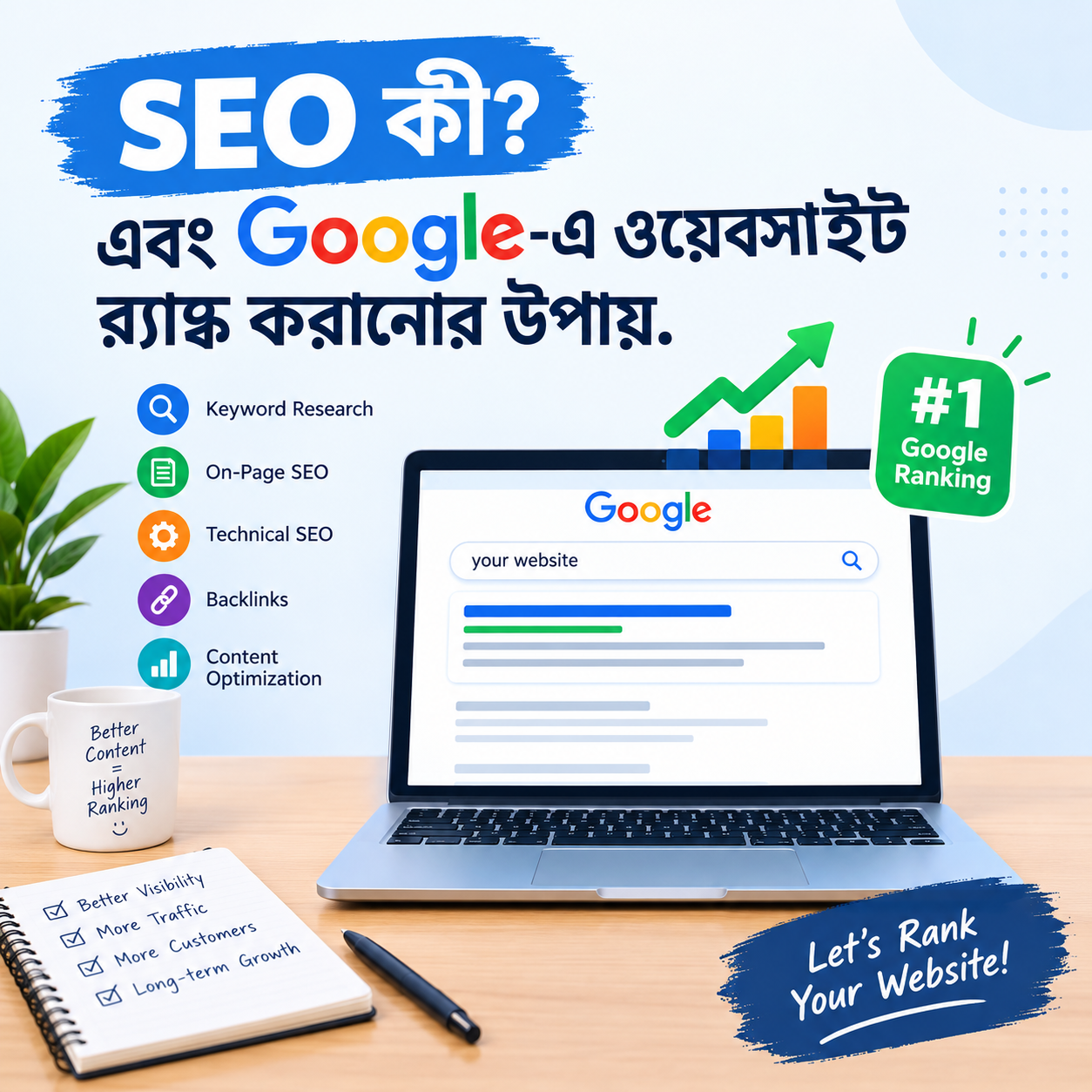
What Is SEO and How to Rank a Website on Google? A Complete Beginner’s Guide
Have you ever wondered why some websites appear on the first page of Google while others struggle to get visitors? The answer often lies in Search Engine Optimization (SEO). Whether you run a business website, manage a blog, or want to build a career in digital marketing, understanding SEO can help you reach the right audience online.
Today, having a website is not enough. People need to find it when they search for information, products, or services. This is where SEO becomes important. With the right strategy, you can improve your website’s visibility, attract relevant visitors, and build long-term organic traffic without paying for every click.
In this guide, we will explain what SEO is, how Google ranks websites, and how to rank a website on Google step by step.
What Is SEO?
SEO stands for Search Engine Optimization. It is the process of improving a website so that search engines like Google can understand its content and show it to users searching for relevant information.
For example, imagine someone searches for “best digital marketing course in Bangladesh.” If your website offers digital marketing training and has helpful, relevant content, SEO can help your page appear in the search results.
SEO does not guarantee a first-page ranking. Instead, it focuses on making your website more useful, accessible, relevant, and trustworthy for both users and search engines.
Why Is SEO Important for a Website?
SEO is important because it helps people discover your website when they are actively looking for something related to your business or content.
Here are some key benefits of SEO:
Increases organic traffic: Attract visitors from unpaid search results.
Improves online visibility: Help more people discover your brand.
Builds trust and credibility: Useful content and a good user experience can strengthen your reputation.
Generates potential customers: Reach people who are already interested in your products or services.
Supports long-term growth: Well-maintained content can continue attracting visitors over time.
Reduces dependence on paid advertising: Organic search can complement your paid marketing campaigns.
For businesses, educational institutions, bloggers, and freelancers, SEO is an important part of a sustainable digital marketing strategy.
How Does Google Rank Websites?
Google uses automated systems to discover, understand, and organize web pages. When someone searches for something, Google tries to show results that are relevant and helpful for that particular query.
Several factors can influence search rankings, including:
Relevance: How closely the page matches the user's search intent.
Content quality: Whether the content provides useful, reliable, and sufficiently detailed information.
Page experience: Whether the website is easy to use, secure, and works well on different devices.
Links and reputation: Links from relevant, trustworthy websites can help Google discover pages and understand their importance.
Context: Google may consider factors such as the user's location and the meaning of the query.
There is no single trick that guarantees a top ranking. Successful SEO requires a combination of useful content, technical improvements, and ongoing analysis.
How to Rank a Website on Google: 8 Practical Steps
1. Start with Keyword Research
Keyword research is one of the first steps in SEO. It helps you understand what your target audience searches for on Google.
For example, if you run an IT training institute in Bangladesh, your potential keywords might include:
Digital marketing course in Bangladesh
SEO course in Bangladesh
Best IT training institute in Bangladesh
Data analytics course for beginners
How to learn digital marketing
Choose keywords that match your website's services and the needs of your audience.
You can use tools such as Google Keyword Planner, Google Trends, and Google Search Console to research keywords and understand search performance.
Do not choose keywords based only on search volume. Consider search intent, competition, relevance, and whether the topic can attract the right audience.
2. Create Helpful, High-Quality Content
Content plays a major role in SEO. Your website should answer the questions people are actually asking instead of simply repeating keywords.
Before writing a blog post, search for your target topic on Google. Review the types of pages that appear and identify what information readers need. Then create content that answers their questions clearly and provides additional value.
For example, an article about learning SEO could explain keyword research, on-page optimization, technical SEO, link building, and common beginner mistakes.
To improve content quality:
Write in clear, natural language.
Organize information with meaningful headings.
Use practical examples and original insights.
Keep information accurate and up to date.
Avoid unnecessary repetition and keyword stuffing.
Review your content regularly and update it when needed.
AI tools can help with research and drafting, but the final article should be checked for accuracy, originality, usefulness, and your own experience.
3. Optimize Your On-Page SEO
On-page SEO means optimizing elements within a web page to help search engines understand its topic and help readers navigate the content.
Important on-page SEO elements include:
SEO title: Write a clear title that accurately describes the page and includes the main keyword naturally.
Meta description: Create a concise summary that encourages users to visit your page. Google may generate a different search snippet depending on the query.
URL structure: Use short, descriptive URLs that make the page topic easy to understand.
Headings: Use an H1 for the main page heading and H2 or H3 headings to organize supporting topics.
Image optimization: Use descriptive file names and meaningful alt text for informative images. Compress images where appropriate to improve loading performance.
Internal links: Link to relevant pages within your own website so visitors can discover related information.
For example, a blog about SEO can link to your digital marketing course page when it is genuinely useful to the reader.
Remember that on-page SEO should improve the user experience, not make the page look as though it was written only for search engines.
4. Improve Technical SEO
Technical SEO focuses on helping search engines access, crawl, and understand your website.
Even excellent content can struggle to perform if important pages cannot be crawled or indexed.
Here are some essential technical SEO tasks:
Make sure your website uses HTTPS.
Check whether important pages can be indexed.
Create and submit an XML sitemap through Google Search Console.
Review your robots.txt file to ensure it does not accidentally block important pages.
Fix broken internal links and unnecessary redirect chains.
Use a responsive design that works on mobile devices.
Improve page loading performance and Core Web Vitals where possible.
Check for duplicate URLs and other indexing issues.
Google Search Console is particularly useful because it helps you monitor indexing, search queries, clicks, impressions, and technical problems.
You do not need to fix every technical issue immediately. Start with problems that prevent important pages from being discovered, indexed, or used effectively.
5. Build Quality Backlinks
Backlinks are links from other websites pointing to your website. They can help search engines discover your content and provide context about your site's reputation.
However, not all backlinks are equally valuable. A relevant editorial link from a trustworthy website is generally more useful than hundreds of irrelevant or artificially created links.
You can earn backlinks through several approaches:
Publish original research, useful guides, or free resources.
Create content that other websites naturally want to reference.
Contribute genuinely useful articles to relevant publications.
Build relationships with businesses, educators, and industry professionals.
Share practical case studies and original project examples.
Avoid buying links intended to manipulate rankings, participating in link schemes, or creating large numbers of low-quality backlinks.
The goal should be to build genuine authority and visibility rather than chase backlink numbers.
6. Optimize Your Website for Mobile Users
Many people browse the internet using smartphones, especially when searching for courses, local services, and business information.
A website that is difficult to use on a mobile device can frustrate visitors and reduce the chances that they will contact your business.
To improve the mobile experience:
Use readable font sizes.
Make buttons and navigation easy to tap.
Ensure content fits the screen without unnecessary horizontal scrolling.
Avoid intrusive pop-ups.
Optimize images and other page resources.
Make contact forms simple to complete.
Google primarily uses the mobile version of a website's content for indexing. Therefore, make sure your mobile site contains the important content and links available on your desktop version.
7. Use Internal Linking Strategically
Internal links connect one page of your website to another. They help users explore related content and help search engines understand the relationship between your pages.
For example, an IT training institute could publish a main guide titled “What Is Digital Marketing?” and connect it to supporting articles about SEO, Google Ads, keyword research, and social media marketing.
Each supporting article can then link back to the main guide and to the relevant course page.
Use descriptive anchor text that tells readers what they can expect after clicking. Avoid adding links where they do not provide genuine value.
A well-planned internal linking structure can improve content discovery and help guide potential students from informational articles to course information.
8. Monitor Results and Improve Your SEO Strategy
SEO is not a one-time task. You need to monitor performance, identify problems, and improve your website based on actual data.
Google Search Console helps you understand which search queries generate impressions and clicks, which pages perform well, and whether indexing issues need attention.
Google Analytics 4 can help you analyze visitor behavior and measure meaningful actions, such as course enquiries or form submissions, when tracking is configured correctly.
Review these metrics regularly:
Impressions: How often your pages appear in search results.
Clicks: How many people visit from search results.
Click-through rate (CTR): The percentage of impressions that result in clicks.
Average position: An aggregated indication of your search ranking performance.
Conversions: How many visitors complete meaningful actions.
If a page receives impressions but few clicks, consider whether its title and description accurately communicate its value. If visitors arrive but do not enquire, review the content, user experience, and call to action.
SEO results vary by website and competition. Some improvements may show progress relatively quickly, while building meaningful organic visibility can take months.
Common SEO Mistakes to Avoid
Beginners often focus on shortcuts instead of building a strong foundation. Avoid these common mistakes:
Stuffing the same keyword into every paragraph.
Copying articles from other websites.
Publishing AI-generated content without proper review or added value.
Ignoring mobile usability and page indexing.
Buying spammy backlinks.
Using misleading titles that do not match the content.
Neglecting internal links.
Expecting immediate first-page rankings.
Google aims to provide helpful and relevant results. Your best long-term approach is to serve your audience well while following sound SEO practices.
Frequently Asked Questions About SEO
1. What is SEO in digital marketing?
SEO is the process of improving a website's visibility in organic search results. It helps businesses attract relevant visitors through search engines without paying for every click.
2. How long does SEO take to show results?
SEO results depend on competition, website condition, content quality, and the work involved. Google notes that some changes can take days to be reflected, while meaningful improvements commonly take several months. No specific ranking timeline is guaranteed.
3. Can I learn SEO without coding?
Yes. You can learn many SEO fundamentals without coding, including keyword research, content optimization, internal linking, and Search Console analysis. Technical SEO may require basic HTML knowledge or developer support for more complex issues.
4. Is SEO free?
Organic search traffic does not require payment for each click. However, SEO still requires time, skills, content creation, tools, and sometimes professional support.
5. What are the most important SEO tools for beginners?
Google Search Console, Google Analytics 4, Google Keyword Planner, and Google Trends are useful starting points. Other tools can help with competitor analysis, keyword research, and technical audits.
6. Can a new website rank on Google?
Yes. New websites can rank when they publish relevant, useful content and provide a good user experience. However, competition, website authority, search intent, and other factors influence how quickly pages gain visibility.
Conclusion
Learning how to rank a website on Google starts with understanding your audience and creating content that genuinely helps them. Keyword research, on-page SEO, technical optimization, quality backlinks, mobile usability, and performance monitoring all contribute to a strong SEO strategy.
You do not need to master everything on the first day. Start with one page, identify the right keywords, improve the content, and measure the results. As your knowledge grows, you can apply these techniques to more pages and build a stronger online presence.
If you want to develop practical skills in SEO and digital marketing, structured learning and hands-on projects can help you build a solid foundation.
Ready to build your digital marketing skills? Explore the courses offered by Unique IT Institute and take the next step toward your learning and career goals.
Visit Unique IT Institute to explore available training programs.